Homework 5 Solutions
ChE 621 — Thermodynamics.
Problem 1
Part (a): the slope of the ice-water boundary
\[\frac{\mathrm{d}P}{\mathrm{d}T_{\mathrm{m}}} = \frac{Δ\tilde{H}^{\mathrm{sl}}}{T_{\mathrm{m}} Δ\tilde{V}^{\mathrm{sl}}} = \frac{6000}{273.15 \cdot \left(\frac{18}{1.0} - \frac{18}{0.92}\right) \cdot 10^{-6}} = -140.34 \ (\text{bar/K})\]
Part (b): the skater’s pressure and the lowest ice temperature
\[P = \frac{mg}{A} = \frac{100 \times 9.8}{0.3 \times 0.1 \times 10^{-3}} = 326.67 \ (\text{bar})\]
\[\mathrm{d}P = \frac{Δ\tilde{H}^{\mathrm{sl}}}{Δ\tilde{V}^{\mathrm{sl}}} \cdot \mathrm{d}\ln T_{\mathrm{m}} \implies P - P_{0} = \frac{Δ\tilde{H}^{\mathrm{sl}}}{Δ\tilde{V}^{\mathrm{sl}}} \cdot \ln \frac{T_{\mathrm{m}}}{T_{\mathrm{m}0}}\]
\[T_{\mathrm{m}} = T_{\mathrm{m}0} \cdot \exp\left[\frac{(P - P_{0}) Δ\tilde{V}^{\mathrm{sl}}}{Δ\tilde{H}^{\mathrm{sl}}}\right] = 273.15 \cdot \exp\left(\frac{326.67 - 1.01325}{-140.34 \times 273.15}\right)\]
\[= 270.84 \text{ K} \quad \text{or} \quad -2.3 \text{ °C}\]
Part (c): skating at −9 °C
No. Based on the argument here, you can calculate that \(P = 0.129\) GPa is needed to have liquid water at −9 °C, and that the blade width needs to be 25 \(μ\) m. Still unlikely.
Problem 2
\[V_{\mathrm{t}} = n_{\mathrm{H}_{2}\mathrm{O}} \bar{V}_{\mathrm{H}_{2}\mathrm{O}} + n_{\mathrm{EtOH}} \bar{V}_{\mathrm{EtOH}}\]
\[= \frac{V_{\mathrm{H}_{2}\mathrm{O}}}{\tilde{V}_{\mathrm{H}_{2}\mathrm{O}}} \bar{V}_{\mathrm{H}_{2}\mathrm{O}} + \frac{V_{\mathrm{EtOH}}}{\tilde{V}_{\mathrm{EtOH}}} \bar{V}_{\mathrm{EtOH}}\]
We want
\[n_{\mathrm{H}_{2}\mathrm{O}} \tilde{V}_{\mathrm{H}_{2}\mathrm{O}} = n_{\mathrm{EtOH}} \cdot \tilde{V}_{\mathrm{EtOH}}\]
\[\implies \frac{n_{\mathrm{H}_{2}\mathrm{O}}}{n_{\mathrm{EtOH}}} = \frac{58}{18} \quad \text{or} \quad x_{\mathrm{EtOH}} = \frac{9}{38} \approx 0.237\]
Read from the graph, \(\bar{V}_{\mathrm{H}_{2}\mathrm{O}} = 17.6\) cm³/mol and \(\bar{V}_{\mathrm{EtOH}} = 55.7\) cm³/mol.
\[\therefore\; \frac{V}{18} \times 17.6 + \frac{V}{58} \times 55.7 = 100\]
\[\implies V = V_{\mathrm{H}_{2}\mathrm{O}} = V_{\mathrm{EtOH}} = 51.6 \text{ cm}^{3}\]
Problem 3
The chemical potential of \(\mathrm{CO}_{2}\) in the vapor phase and in the rubber:
\[μ_{\mathrm{CO}_{2}}^{\mathrm{V}} = μ_{\mathrm{CO}_{2}}^{\mathrm{sol}} = μ_{\mathrm{CO}_{2}}^{*} + RT \ln x_{\mathrm{CO}_{2}} \qquad \text{(1) ideal solution}\]
where
\[x_{\mathrm{CO}_{2}} = \frac{n_{\mathrm{CO}_{2}}}{n_{\mathrm{CO}_{2}} + n_{\text{rubber}}} \approx \frac{n_{\mathrm{CO}_{2}}}{n_{\text{rubber}}} = \frac{P^{\ominus} \cdot s}{10^{6} R T^{\ominus} \cdot n_{\text{rubber}}}\]
((2) \(n_{\mathrm{CO}_{2}} \ll n_{\text{rubber}}\) ; (3) \(\mathrm{CO}_{2}\) is an ideal gas at S.T.P.)
\[\therefore\; \ln x_{\mathrm{CO}_{2}} = \frac{μ_{\mathrm{CO}_{2}}^{\mathrm{V}} - μ_{\mathrm{CO}_{2}}^{*}}{RT}\]
\[\left(\frac{\partial \ln x_{\mathrm{CO}_{2}}}{\partial T}\right)_{P} = \left(\frac{\partial \ln s}{\partial T}\right)_{P} = -\frac{\tilde{H}_{\mathrm{CO}_{2}}^{\mathrm{V}}}{RT^{2}} + \frac{\bar{H}_{\mathrm{CO}_{2}}}{RT^{2}} = \frac{Δ\tilde{H}_{\mathrm{s}}}{RT^{2}}\]
The assumptions made are numbered (1) to (3) above:
ideal solution;
\(n_{\mathrm{CO}_{2}} \ll n_{\text{rubber}}\) ;
\(\mathrm{CO}_{2}\) is an ideal gas at S.T.P.
Problem 4
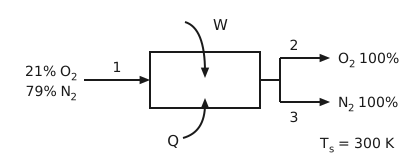
Figure 1 The air separator. A rectangle stands for the separator. Stream 1, labelled 21% \(\mathrm{O}_{2}\) and 79% \(\mathrm{N}_{2}\) , enters it from the left. A curved arrow labelled \(W\) enters through the top edge and one labelled \(Q\) through the bottom edge, both pointing to the middle of the box. A single line leaves the right edge and splits in two: stream 2, the upper branch, leaves as 100% \(\mathrm{O}_{2}\) and stream 3, the lower branch, as 100% \(\mathrm{N}_{2}\) . Below the outlets, \(T_{\mathrm{s}} = 300\) K.
The numbers in parentheses mark the assumptions, which are listed at the end of the problem.
At steady state:
\[0 = \dot{W} + \dot{Q}\]
Entropy balance:
\[\dot{n}_{3} \cdot \tilde{S}_{3} + \dot{n}_{2} \cdot \tilde{S}_{2} - \dot{n}_{1} \cdot \tilde{S}_{1} = \frac{\dot{Q}}{T_{\mathrm{s}}} + \underbrace{\cancel{Δ\dot{S}_{\text{gen}}}}_{(1)}\]
For each stream:
\[\tilde{S}_{i} = \sum_{i} x_{i} \tilde{S}_{i}^{\mathrm{ig}} - R \sum_{i} x_{i} \ln x_{i} \qquad (2)\]
Take the pure species at 300 K as the reference, so that \(\tilde{S}_{2} = 0\) and \(\tilde{S}_{3} = 0\) . We have
\[\tilde{S}_{1} = -R \sum_{i} x_{i} \ln x_{i} = -R (0.21 \ln 0.21 + 0.79 \ln 0.79)\]
\[\therefore\; -\dot{n}_{1} \tilde{S}_{1} = \frac{\dot{Q}}{T_{\mathrm{s}}} \implies \frac{\dot{W}}{\dot{n}_{1}} = -\frac{\dot{Q}}{\dot{n}_{1}} = 1.282 \text{ kJ/mol}\]
Alternatively, for the isothermal separation,
\[\begin{split}\begin{aligned}
Δ\tilde{G} &= \left[x_{\mathrm{O}_{2}} \tilde{G}_{\mathrm{O}_{2}}(P) + x_{\mathrm{N}_{2}} \tilde{G}_{\mathrm{N}_{2}}(P)\right] - \left[x_{\mathrm{O}_{2}} \bar{G}_{\mathrm{O}_{2}}(P) + x_{\mathrm{N}_{2}} \bar{G}_{\mathrm{N}_{2}}(P)\right] \\
&\overset{(2)}{=} \left[x_{\mathrm{O}_{2}} μ_{\mathrm{O}_{2}}^{\mathrm{g}}(P) + x_{\mathrm{N}_{2}} μ_{\mathrm{N}_{2}}^{\mathrm{g}}(P)\right] - \left[x_{\mathrm{O}_{2}} μ_{\mathrm{O}_{2}}^{\mathrm{g}}(P x_{\mathrm{O}_{2}}) + x_{\mathrm{N}_{2}} μ_{\mathrm{N}_{2}}^{\mathrm{g}}(P x_{\mathrm{N}_{2}})\right] \\
&\overset{(2)}{=} -RT_{\mathrm{s}} (x_{\mathrm{O}_{2}} \ln x_{\mathrm{O}_{2}} + x_{\mathrm{N}_{2}} \ln x_{\mathrm{N}_{2}}) = 1.282 \text{ kJ/mol}
\end{aligned}\end{split}\]
is the minimum amount of energy that must be provided (1).
We have assumed:
a reversible process;
ideal gases (and ideal gas mixtures).