Homework 3 Solutions
ChE 621 — Thermodynamics.
Problem 1
Part (a): the stress in terms of isothermal derivatives
At constant \(T\), divide by \(\mathrm{d}ε\):
Part (b): reading the two contributions from the stress-temperature data
Define the first Legendre transform \(A = U - TS\). We have
The corresponding Maxwell relation is
So on the constant-\(ε\) plot of \(σ\) against \(T\), the tangent has the slope
The tangent line
matches Equation (1) at the point \((T, σ)\). We can therefore identify the intercept
Part (c): a stress proportional to temperature
\(σ = cT\), that is, \(b = 0\): there is no energetic contribution. The elastic response is all due to the change in entropy.
Problem 2
Part (a): an energy function of \(T\) and \(M\)
The Maxwell relation is
Part (b): the entropy change
using the Maxwell relation from part (a). At fixed \(M\),
Parts (c) and (d): the lowest possible final temperature
For a reversible adiabatic demagnetization process,
Part (e): the comparison with an expanding ideal gas
The Curie equation of state (\(M\)-\(H\)-\(T\)) is just like the ideal-gas equation of state. In the adiabatic process (expansion and demagnetization), \(\mathrm{d}S\) will be zero, and both the \(-P \mathrm{d}V\) term and the \(μ_{0} V H \mathrm{d}M\) term will lead to a decrease of the internal energy, which will lead to a decrease of the temperature. Thus, this cooling method is similar to the adiabatic expansion of an ideal gas.
Problem 3
From the triple product rule, we know that
Also,
Recall the Maxwell relation
Substitute Equation (4) into Equation (2):
Recall
and its Maxwell relation
Substitute Equation (6) into Equation (3):
Thus,
This result is acceptable. Alternatively, using the triple product rule, \(\left(\frac{\partial T}{\partial V}\right)_{P} \left(\frac{\partial P}{\partial T}\right)_{V} = -\left(\frac{\partial P}{\partial V}\right)_{T}\), so
Therefore, if we have a \(P\)-\(V\)-\(T\) equation of state, for example, assuming air behaves like ideal gas (\(PV = nRT\)),
then with \(C_{P} = 7/2 R\) and \(C_{V} = 5/2 R\) for diatomics and \(M = 29\) g/mol, we can obtain the speed of sound:
at \(T = 298\) K, almost spot on.
Problem 4
Take as the system a thin slab of the pipe, between section 1 at \(x\) and section 2 at \(x + \mathrm{d}x\), as in Figure 1.
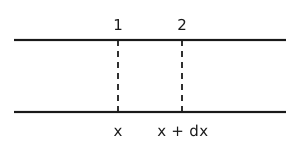
Figure 1 A slab of the pipe. Two long horizontal lines are the walls of a straight pipe. Two dashed vertical lines cross the pipe from wall to wall, close together, and mark off a thin slab of it. The left one is labelled 1 above the pipe and \(x\) below it, and the right one is labelled 2 above and \(x + \mathrm{d}x\) below.
The energy balance on the slab is
and the mass balance is
Equation (8) and Equation (9) show that
or
Equation (9) means that
or
The entropy balance is
Equation (9) and Equation (10) give
Problem 5
Part (a): Stirling’s approximation as an integral
Part (b): the next term, from a Taylor expansion of \(g(x)\)
Let
so that
or